
Clinical Insights
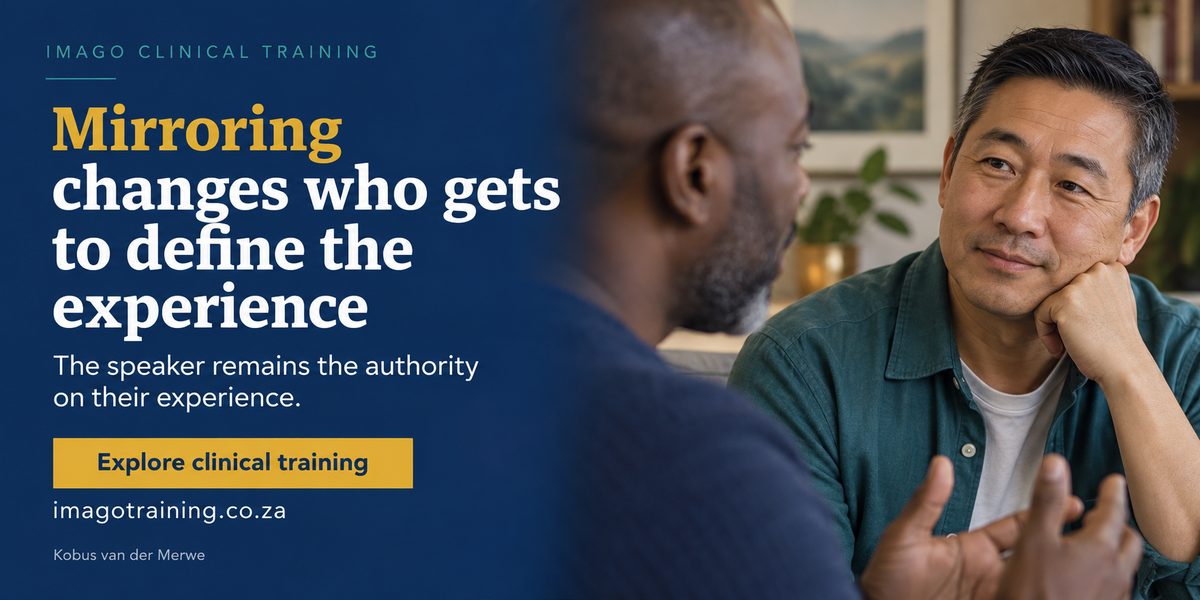
Mirroring changes who gets to define the experience
Understanding the clinical work inside a seemingly simple reflection
A partner speaks about feeling unimportant. Before the sentence is finished, the other explains why that conclusion is inaccurate. The speaker then tries harder to establish the legitimacy of the experience, and the receiver becomes more invested in disproving it. The exchange is organised around who has the authority to decide what the speaker should feel.
Mirroring intervenes at this point. In Imago Dialogue, the receiver reflects the sender’s message and invites correction before responding from their own perspective. The clinical significance lies in the change this introduces into the interaction. For a period, understanding the other’s experience becomes a shared task, and the sender can influence how that experience is received.
Accuracy as a relational experience
A mirror does not need theatrical precision or a particular accent. It needs to carry the sender’s meaning accurately enough for the sender to recognise it. Short sends make this more manageable. A receiver can ask to reflect what they have heard so far, and the sender can add the part that is missing.
The accuracy check is therefore an intervention in its own right. A simple ‘Have I understood you?’ creates an opening for difference. The therapist attends to what follows a correction. Does the receiver adjust with interest, or insist that the original mirror was already good enough? Can the sender clarify without humiliating the listener? The method makes these moments available for work.
A teaching example might involve a sender saying, ‘When we make decisions quickly, I struggle to feel included.’ If the receiver reflects, ‘You think I make every decision,’ the therapist helps recover the original meaning. ‘Ask your partner which part you have and what still needs to be heard.’ We return interpretive authority to the person describing their experience.
Difference remains present
Accurately hearing subjective experience does not require accepting every factual assertion in an account. The therapist can help distinguish an observable event, the meaning attached to it and the feeling that followed. Contested facts may still require careful attention. Dialogue should never be used to demand agreement with a false claim or to obscure harmful conduct.
Once the message has been mirrored and summarised, validation recognises how the sender’s perspective makes sense from their position. Empathy tentatively identifies the emotional experience and checks it. A receiver who cannot yet validate can ask for clarification. Prompting an unearned ‘That makes sense’ may create compliance while leaving the relationship unchanged.
This is part of what Imago calls differentiation: two people can retain distinct experiences while remaining in contact. The receiver’s perspective receives its own turn. Neither partner has to disappear for the other to be heard, and understanding need not wait for a shared interpretation of the entire situation.
When the form becomes a performance
Couples can reproduce the sentence stems with little relational availability. A receiver may speak accurately while looking contemptuous or waiting for permission to launch a rebuttal. A sender may use the protected turn to deliver an accusation. In either case, the therapist needs to intervene in the interaction rather than simply move to the next step.
An intervention could be, ‘The words have been reflected. Let us check how they were received before we continue.’ The sender is invited to describe the experience without evaluating the receiver’s worth. The receiver can acknowledge distraction, uncertainty or difficulty. This keeps the structure responsive to the people using it.
Pacing and accessibility also matter. Some people benefit from shorter segments, visual prompts or more time to formulate a response. Eye contact and touch are not required evidence of engagement. We adapt the form while preserving its purpose: accurate receiving, respect for difference and voluntary participation. Safety includes freedom from being judged for a particular style of attention.
What a useful mirror makes possible
The relevant observations extend beyond whether a phrase was repeated correctly. Can the sender speak with less need to prove? Can the receiver remain curious when the meaning differs from what they expected? Can both describe what changed, or did not change, during the exchange? Their answers guide how much support the next turn requires.
Mirroring offers a repeatable opportunity for partners to encounter one another without immediate correction or appropriation. It becomes clinically significant through the relationship that develops around it. Training must therefore address the stance and timing of facilitation alongside the verbal sequence. Knowing the stems is the beginning of learning the method.
To study mirroring, validation and empathy as clinical processes, explore Imago Clinical Training at imagotraining.co.za. The training invitation is to learn how to facilitate the encounter as well as the words.